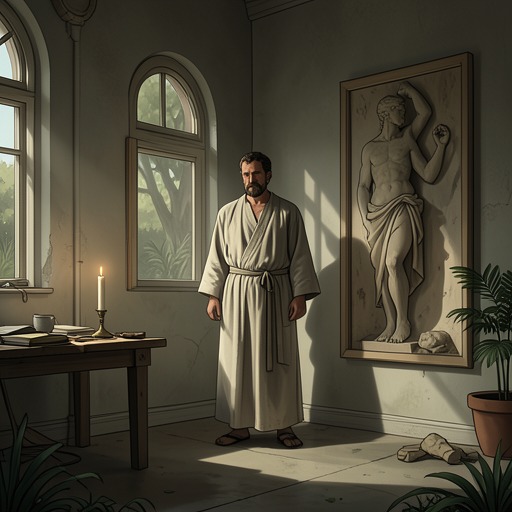
“Death and ecstasy were one”
Narcissus and Goldmund“Death and ecstasy were one” names a recurring insight in Goldmund’s life: intense pain, sexual ecstasy, birth, and dying can bear a startling resemblance, and desire is inseparable from its brevity and loss. The idea begins in a witnessed birth, deepens through his exposure to death and mortal danger, and eventually informs his image of the mother as both the source of life and the presence that receives it back. It is not simply a claim that opposites look alike. For Goldmund, their likeness connects bodily experience to artistic form and to a vision of existence in which creation and destruction belong together.
The First Recognition
Goldmund’s first clear experience of this resemblance comes while he is wandering. In a poor village where he has found shelter, a peasant woman gives birth during the night. He is woken from the straw and asked to help, though his task is only to hold a light while the midwife works. Watching the woman’s face, he notices that its expression in extreme pain is not wholly unlike the expressions he has seen in women during sexual ecstasy. The pain is more violent, but the underlying contraction and sudden intensification seem to him essentially the same. He is surprised by the discovery that pain and joy can resemble one another so closely.
The insight arises through looking rather than through a theory already formed. Goldmund has not set out to explain birth or desire; he is confronted with a face changed by an experience he has never witnessed before. The similarity he perceives makes the body a kind of evidence: contrary states can share an expressive shape, even when their circumstances and meanings differ. The episode provides a concrete beginning for a thought that will recur as he encounters other forms of suffering and approaches art.
Experience, Memory, and Mortality
After a winter journey with Viktor, Goldmund is brought back to the same village, exhausted and near death. Recovered in the warmth of a stable and with the peasant woman’s goat’s milk, he reflects on the recent experiences that have become at once nearly past and impossible to forget. His thoughts return to the woman crying out in childbirth, Viktor’s death, and his own struggle to survive hunger and cold. The expressions associated with birth, ecstasy, and dying remain connected in his memory, while the knowledge of how small and threatened a person can be accompanies an intense awareness of the force of life.
The observation therefore develops beyond a comparison between childbirth and sexual passion. Goldmund has faced the possibility of his own death, and the experience leaves him with a sense of life’s tenacity as well as its vulnerability. His remembrance gathers different events without making them identical: a birth, a companion’s death, and his own fight to live retain their distinct circumstances, yet each belongs to a pattern in which bodily intensity and mortality meet. He feels these experiences can perhaps be spoken of with Narcissus, but not with anyone else, marking the insight as difficult to communicate even as it becomes central to his understanding.
Goldmund later gives the connection a concise name: death and ecstasy belong together. His account of life does not separate desire from melancholy. Ecstasy is intense partly because it cannot last; the knowledge that it will vanish is present at its height. Conversely, melancholy is not a permanent escape from desire: it may be displaced by a renewed surrender to life. For him, the mother is the figure through whom these turns become intelligible. She is associated with love and desire, but also with death, the grave, and decay; she gives life and takes it away. The image is neither simply consoling nor simply fearful. It holds tenderness and cruelty, generation and ending, within the same maternal figure.
From Insight to Artistic Purpose
Goldmund’s encounter with Master Niklaus’s wooden Madonna gives the insight an artistic point of focus. After confessing his past in a cloister, Goldmund sees the statue in a side chapel and is repeatedly drawn back to it. Its delicately inclined posture, extended hand, and living expression move him deeply. The priest explains that the statue is controversial: some viewers consider it too worldly and modern to represent the mother of God, though it was made by the respected carver Master Niklaus. To Goldmund, the work gives visible form to something he had long sensed.
When he later asks Niklaus to teach him, Goldmund explains that he has thought about the correspondences among bodily forms and the temperaments they express. He recalls the woman’s labor and says that the most intense pain and ecstasy have almost the same expression. He sees that same conjunction in the Madonna: suffering is present in her delicate face, yet it also appears as joy. This recognition prompts him to seek the craft, because the statue seems to confirm that his accumulated thoughts and impressions can become more than private speculation. Niklaus, while impressed by how much Goldmund can say about art, insists that a workshop is a place of work rather than conversation and tests whether the young man can make anything with his hands.
The Madonna also helps Goldmund imagine a work he has not yet made: an image of the universal mother, formed from his memory of his own mother and from later experiences of women. The original personal memory has changed through wandering, longing, danger, and love; the women he has known, including Lise and Lydia, have contributed to an inward figure that no longer represents one particular woman. Goldmund hopes to make visible the source of life itself, and he wants that figure to express the intimate relation between ecstasy, pain, and death. The phrase thus describes an artistic problem as much as a personal conviction: how can a carved image hold apparently contrary forces together without reducing one to the other?
Artistic Form and the Dance of Death
Goldmund’s understanding of art follows the same logic of union. He senses that a genuine work may begin in sensual experience and reach abstraction, or begin in a pure conception and end in living flesh. In his view, its force lies in a double character that joins instinct and spirituality, the worlds of body and mind. The maternal image he hopes to create would embody that conjunction particularly fully, because it would unite the generative and destructive aspects he associates with the mother.
During the plague, Goldmund encounters a recently painted Dance of Death in a cloister. Its skeletons lead representatives of different ranks and occupations—king, bishop, abbot, earl, knight, doctor, peasant, and soldier—out of life while skeletal musicians accompany them. Goldmund recognizes the painting as a forceful lesson in the inevitability of death, but feels that it does not express the whole of what he has experienced. Its death is stern and merciless, whereas the death he perceives also has a seductive, maternal quality: it can seem like a call home, and life may burn more intensely in its presence. This contrast clarifies the distinctiveness of his idea. Death is not only the universal end that makes no exceptions; in Goldmund’s imagination it is also intimately joined to desire, love, and the source from which life comes.
The insight remains grounded in particular encounters rather than becoming a complete explanation of suffering. Goldmund’s artistic attention to the dead in a plague-stricken farmhouse, his vigil beside the dying Lene, and his recollection of the woman giving birth all place bodily change before him as something to witness. He sees distinct lives and deaths, not interchangeable symbols; their shared significance emerges through his attention to faces, gestures, and posture. In this sense the phrase describes both what he believes and how he learns: by looking closely at experiences that cannot be made safe or permanent, then seeking a form capable of preserving their contradiction.